
By Team BuzzBizzAI
21 Jan, 2026
If 2025 had a theme, it was this: AI stopped being a quirky experiment and became the well-oiled machine behind everything marketers do. By year’s end, the question was not whether to use AI, but how confidently — and wisely — you could rely on it.
Looking back, the stories that mattered in 2025 were not just about flashy outputs. They were about how tools changed workflows, pushed boundaries, or tripped over their own ambition.
H&M and Ethical Digital Twins
When H&M used AI to create digital twins of real models under their control, it gave marketers a rare sighting: ethical AI that felt purposeful. Generating content at scale often feels like photocopying creativity. H&M’s version felt more like photocopying compassion, it kept human agency at the centre while automating routine work.
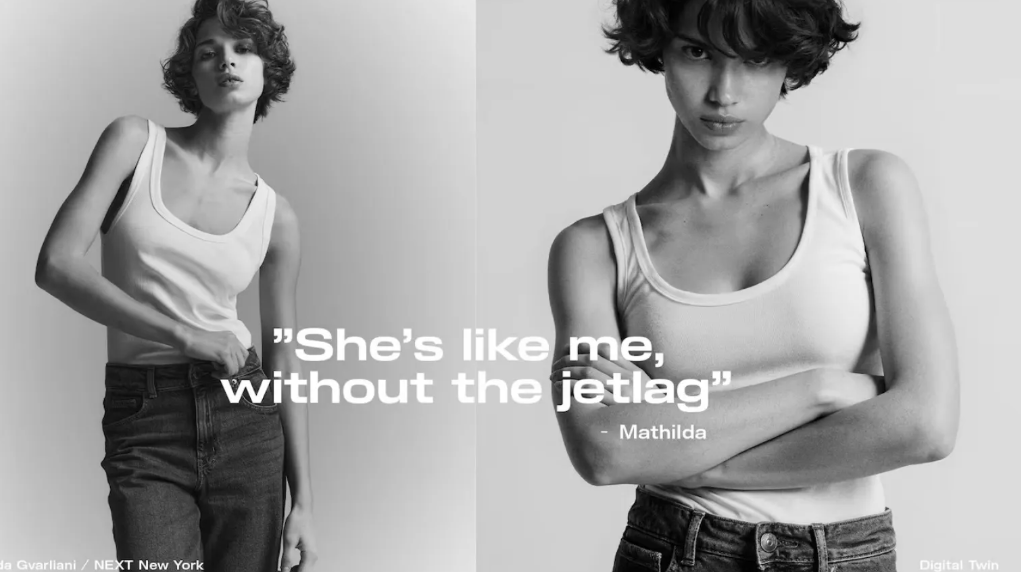
Image Source- H&M
Coca-Cola’s Holiday Campaign
Coca-Cola’s year saw an AI-powered holiday campaign that looked like a thousand holiday cards stacked together. While technically impressive, it lacked the warmth of a classic Coke story. Scale without soul is a lesson that echoed across marketing teams: machines can execute fast. They still struggle to imagine well.
Moonpig’s AI Victories
Moonpig is the unsung hero of 2025. By weaving AI into card personalisation and customer service, the brand made emotional tasks easier. People want convenience, yes. But they also want feeling. Moonpig found that intersection, and it paid off in both satisfaction and sales.
Duolingo’s AI Adventure and Backlash
Duolingo said “AI-first” like a slogan and rolled it into both product and staffing strategy. The company used generative AI to expand its course library and power new features like video practice tools, but not without controversy. Users rallied against perceived drops in content quality and cultural nuance, turning Reddit threads into trending topics. That tension highlighted the gap between productivity gains and user trust in creative spaces.
Momentus Digital’s MoAI Launch
2025 saw new AI infrastructure arrive at scale. Momentus Digital’s MoAI platform aimed to unify creative production, media optimisation, and personalised advertising across channels. Tools like this suggest the next phase of AI is not about novelty. It is about orchestration.
Evertune’s AI Search Optimisation Play
Evertune tackled an emerging frontier: AI visibility. As people increasingly ask AI assistants for recommendations instead of typing queries into search bars, brands want to know how often they appear in those responses. Evertune’s platform measures this kind of AI presence across models like Gemini and ChatGPT, turning AI discovery into a new strategic metric.
Google’s AI at Work and at Play
Across the year, Google expanded its AI ecosystem: Gemini continued to evolve with advanced reasoning, and integrations into Workspace gave marketers tools for copy, summarisation, and visual generation without switching screens. These moves indicate a broader shift where AI is no longer an add-on but embedded into everyday creation and analysis tasks.
The Bigger Picture
2025 was not about AI replacing marketers. It was about AI reshaping the role of marketers. The first generation of use cases focused on automation and content volume. The next phase, which really took shape last year, is about governance, measurement, user trust, and strategic AI discovery.
You do not adopt AI because it is fashionable. You adopt it because it changes outcomes in ways you can measure and defend. If 2025 taught us one thing, it is that tools alone do not make strategy. People do. And in 2026, the teams that win will be the ones who treat AI not as a star performer, but as a reliable ensemble member.
Other Articles

The Best Virtual Brand Assistants Shaping Offices Around The World
Can AI really direct your brand film? Google Flow Reviewed.
No Comment! Be the first one.