

By Team BuzzBizzAI
12 Feb, 2026
Building an online store has always felt like a project. Templates, plugins, back-end logic, design choices, inventory feeds, payment gateways and the whole thing took months. Until now, at least according to Genstore.
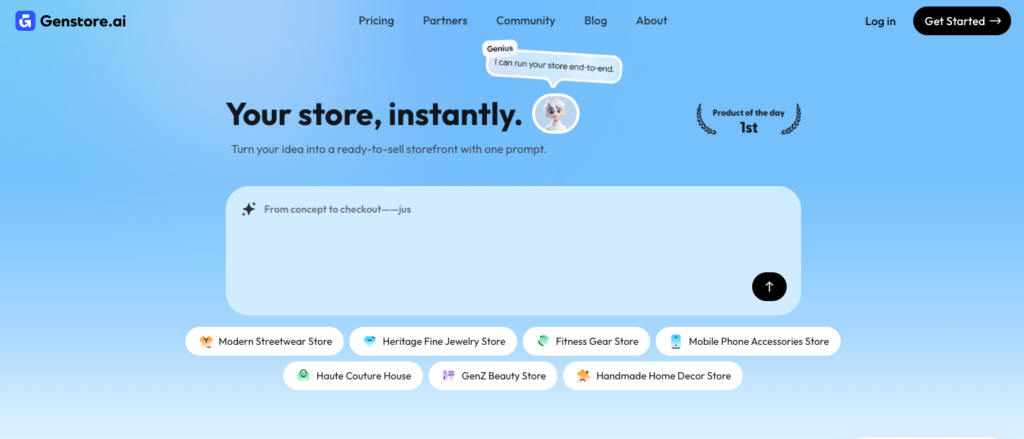
The fledgling commerce platform has rolled out what it calls an AI-native commerce stack powered by autonomous agent teams capable of generating entire, live digital storefronts with almost no human setup. The idea is simple. Instead of telling developers what you want and waiting weeks for execution, you tell an AI agent what you want and let it build, test, and deploy a storefront that works.
Behind the scenes, the system stitches together design, product data, payment logic, layouts, UX flow and checkout mechanics, all orchestrated by “autonomous agent teams.” These are not humans in drag. They are sets of AI processes working in concert to handle tasks that used to require engineers, designers, and operations teams talking to each other.
For marketers, this moves commerce closer to something you prompt into existence rather than program. Imagine a campaign concept in the morning and a functioning store by lunch. The platform promises tight integrations with popular commerce back-ends, plug-in routing for shipping and payments, and ready-to-deploy landing pages that are SEO-ready out of the box. If it works as advertised, the biggest benefit could be turnaround speed.
The autonomous agents are also designed to test flows, catch basic errors, and optimise for performance without continuous human tweaking. This matters because many of the bottlenecks in e-commerce are not creative. They are technical coordination: schema matching, variant logic, cart flows, tax rules, localisation, and more.
A question on many minds is trust. When AI is generating live systems that handle money, inventory, and customer data, how confident can you be that it won’t hallucinate a payment rule or misroute a checkout step? Genstore says enterprise-grade security and compliance are foundational and built into the platform, but the nuance of risk is something marketers will have to test in the wild.
BuzzBizzAI believes that the broader implication is easy to miss. When commerce becomes something you generate rather than assemble, the boundaries between marketing, product, and engineering blur.
Campaigns can be A/B tested not just for messaging but for entire UX funnels. Personalisation can become real-time rather than scheduled. And the notion of a “store” becomes more fluid, more dynamic, more ephemeral, but also more intimately tied to the prompt that summons it.
Critics will point out that real brands are not created by templates. They are shaped by culture, nuance, and strategic vision. AI can scaffold the mechanics quickly. It cannot choose the brand mission for you. But for teams struggling to keep up with demand, this feels like the future arriving not with a splash but a gentle slide into the present.
Source:
Read the full article here:
Other Articles
ChatGPT Ads Are Less About Who You Are and More About What You Are Doing
Turns Out Telling People Your Ad Was Made by AI Might Be the Worst Part

No Comment! Be the first one.